Cloudy water, a chlorine smell that’s either too strong or barely there, or eyes stinging after a swim these are the signs that send people searching for how to test swimming pool water for bacteria. The good news is that home testing tells you a lot, fast, and it’s simpler than most people expect. It just doesn’t answer every question, and knowing where its limits are matters as much as knowing how to do it.
Can You Actually Test for Bacteria at Home?
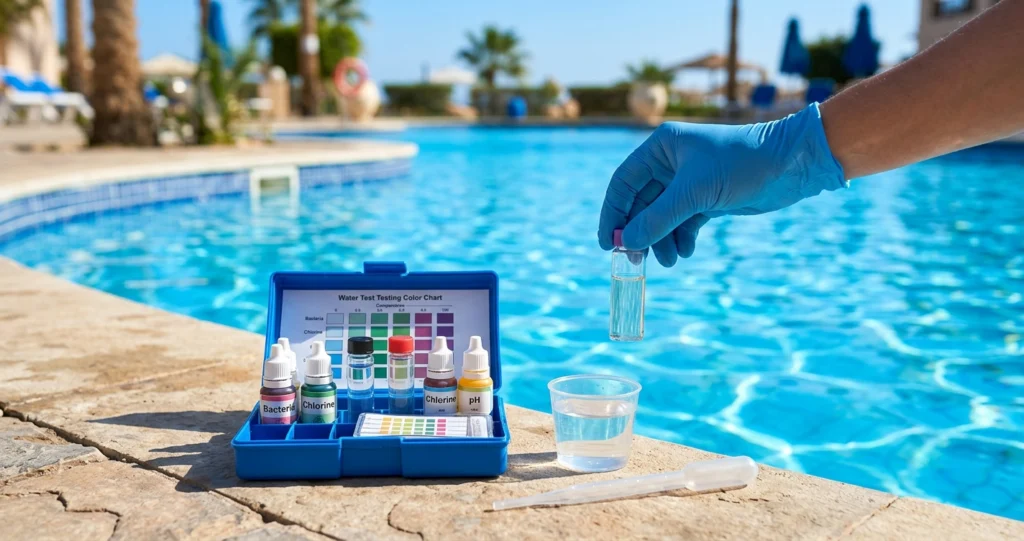
Not directly, no. Home test kits don’t detect bacteria itself no strip or drop kit identifies E. coli or Pseudomonas sitting in your water. What they measure is free chlorine and pH, and those two numbers together tell you whether your water is capable of killing bacteria, which is the practical question most pool owners actually need answered. Direct bacterial identification requires a lab.
Why Chlorine and pH Are the Real Test
The CDC’s guidance on pool water treatment is blunt about this relationship: chlorine kills germs, but how fast depends heavily on pH. At the recommended range, free chlorine can knock out E. coli in under a minute. Push pH above 8.0 and that same chlorine level loses much of its killing power the chlorine is still there, it’s just chemically less able to do its job. Standing water without enough active chlorine is one of the fastest routes to a contamination problem.
So testing for bacteria, in practice, means testing whether your chlorine and pH are in a range where bacteria can’t establish itself:
- Free chlorine: minimum 1 ppm for stabilized outdoor pools, though many UAE pool professionals aim for 2–3 ppm during summer given how fast sunlight and heat burn through chlorine.
- pH: kept between 7.0 and 7.8, with 7.4–7.6 as a comfortable working target that also protects skin, eyes, and pool equipment.
Test strips or a liquid drop kit both work. Liquid kits are more accurate but take a bit longer; strips are faster and fine for routine weekly checks. Either way, test in the morning before the sun has had a chance to burn off overnight chlorine, and always test with the pump running so you’re getting a representative sample rather than water sitting near the surface.
When Home Testing Isn’t Enough
There’s a specific situation where strips and drop kits stop being sufficient: a pool that’s been closed up, sitting stagnant, or drained and left empty for an extended period before refilling. Water that’s sat without circulation or chlorine for weeks common with seasonal villas, properties between tenants, or pools taken offline during renovation can develop biofilm on the walls and in the plumbing lines that a simple chemical test won’t catch. In that case, a proper lab water test is worth the cost, particularly for hotels, gyms, and schools where a facility manager is responsible for bather safety, not just a private garden pool.
A lab test checks for specific bacteria total coliforms, E. coli, sometimes Pseudomonas and gives you a pass/fail against a recognised standard rather than an inferred risk level. If you manage a commercial pool, it’s worth having this done annually regardless of how the water looks, since visual clarity and bacterial safety aren’t the same thing. A pool can look perfectly clear and still fail a bacterial test if chlorine has been running low without anyone noticing.
What to Check Right After a Fresh Delivery
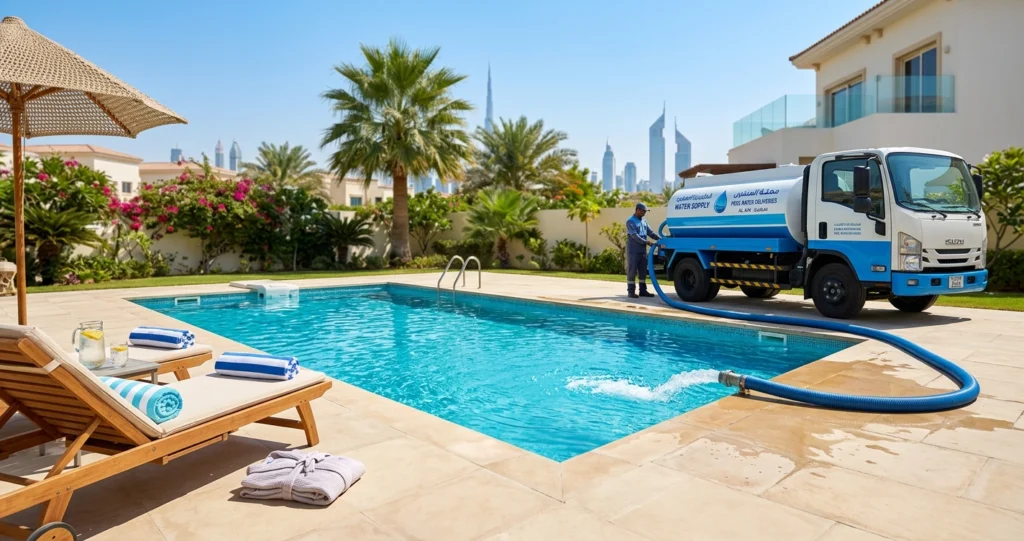
This is a step people skip, and it’s the one place where a delivery company’s own standards matter directly to your safety. Water arriving by licensed tanker should already be tested and treated to UAE municipality drinking-water standards before it’s loaded that’s a baseline the water itself has to meet before it ever touches your pool. But your pool’s chemistry doesn’t automatically match the moment the tanker leaves. Blending new water with whatever was already in the pool, plus your existing filtration and any residual chemicals, changes the balance. Test 30–60 minutes after delivery once the water’s had a chance to circulate, not immediately as the hose disconnects.
If you’re unsure how much water you actually received or need, the pool water volume guide is useful for cross-checking your delivery against your pool’s real capacity under-filling can throw off your chemical dosing calculations.
Signs Your Water Needs Testing Now
- Cloudiness that doesn’t clear after 24 hours of normal filtration
- A strong chemical smell (counterintuitively, this usually means not enough chlorine, not too much that smell comes from chlorine reacting with contaminants, not from chlorine itself)
- Skin or eye irritation that several swimmers report, not just one
- Green tint or visible algae starting to form, especially after a long gap since the last water change
- The pool has been closed, drained, or unused for more than two to three weeks
What to Do If a Test Comes Back Bad
Don’t swim while you fix it. If chlorine is low, shock the pool with an unstabilized chlorine product and retest the next day once levels have settled. If pH is out of range, correct that first chlorine won’t work properly at the wrong pH even if the chlorine level itself looks fine.
For a pool that’s failed a proper bacterial lab test, a full or partial drain and refill with fresh, treated water is usually the safest route rather than trying to chlorine-shock your way out of a contamination problem, particularly for commercial pools with liability exposure.
FAQ
How often should I test for bacteria-related risk at home?
Twice a week for a private villa pool during regular use, daily during heavy summer swimming, and immediately after any refill or extended closure.
Does a bad smell always mean bacteria?
Not necessarily it usually points to low or exhausted chlorine reacting with organic contaminants (sweat, sunscreen, debris), which is exactly the condition bacteria thrive in. Test rather than guess.
Can rainwater or dust introduce bacteria between tests?
Yes, especially after sandstorms, which are common in the UAE and can introduce organic material that consumes chlorine faster than usual, briefly lowering your protection.
Is tanker-delivered water pre-tested for bacteria?
The water itself is tested and treated to municipality standards before dispatch, but your pool’s overall chemistry after delivery still depends on your existing water, filtration, and dosing test after the fill, not just trust the source.
Do I need a lab test if my strips look fine?
Not routinely for a well-maintained private pool. Lab testing is worth doing for commercial pools annually, or for any pool after a long period of stagnation regardless of how a quick strip test reads.
If your pool’s been sitting empty or you’re not confident in its current chemistry, a fresh, tested refill is often the simplest fix. Get a same-day quote or message on WhatsApp to arrange delivery.